
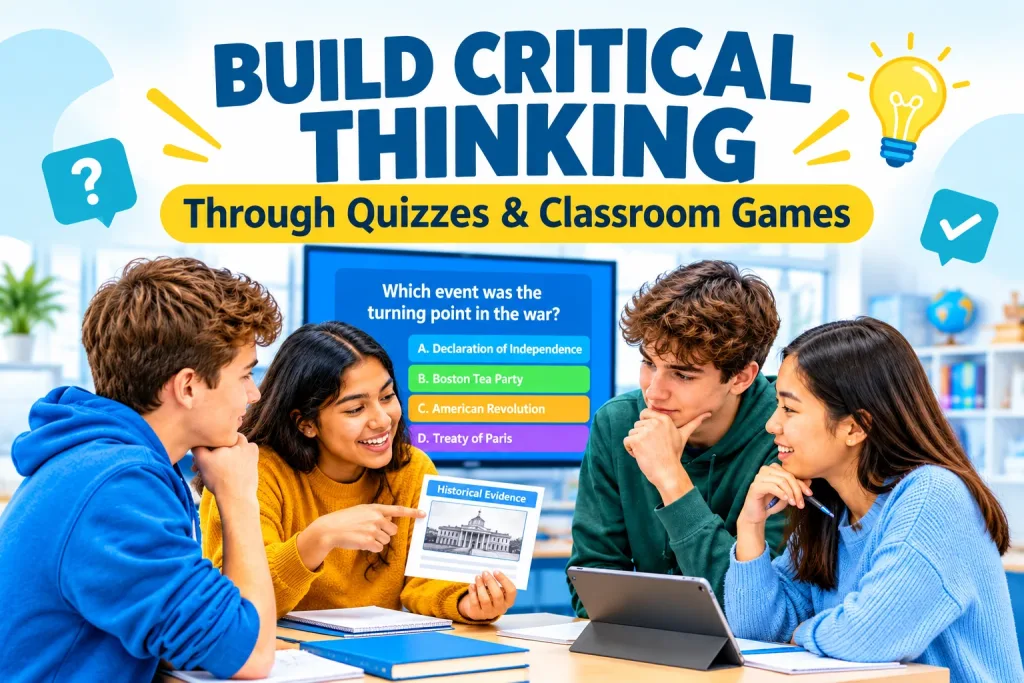
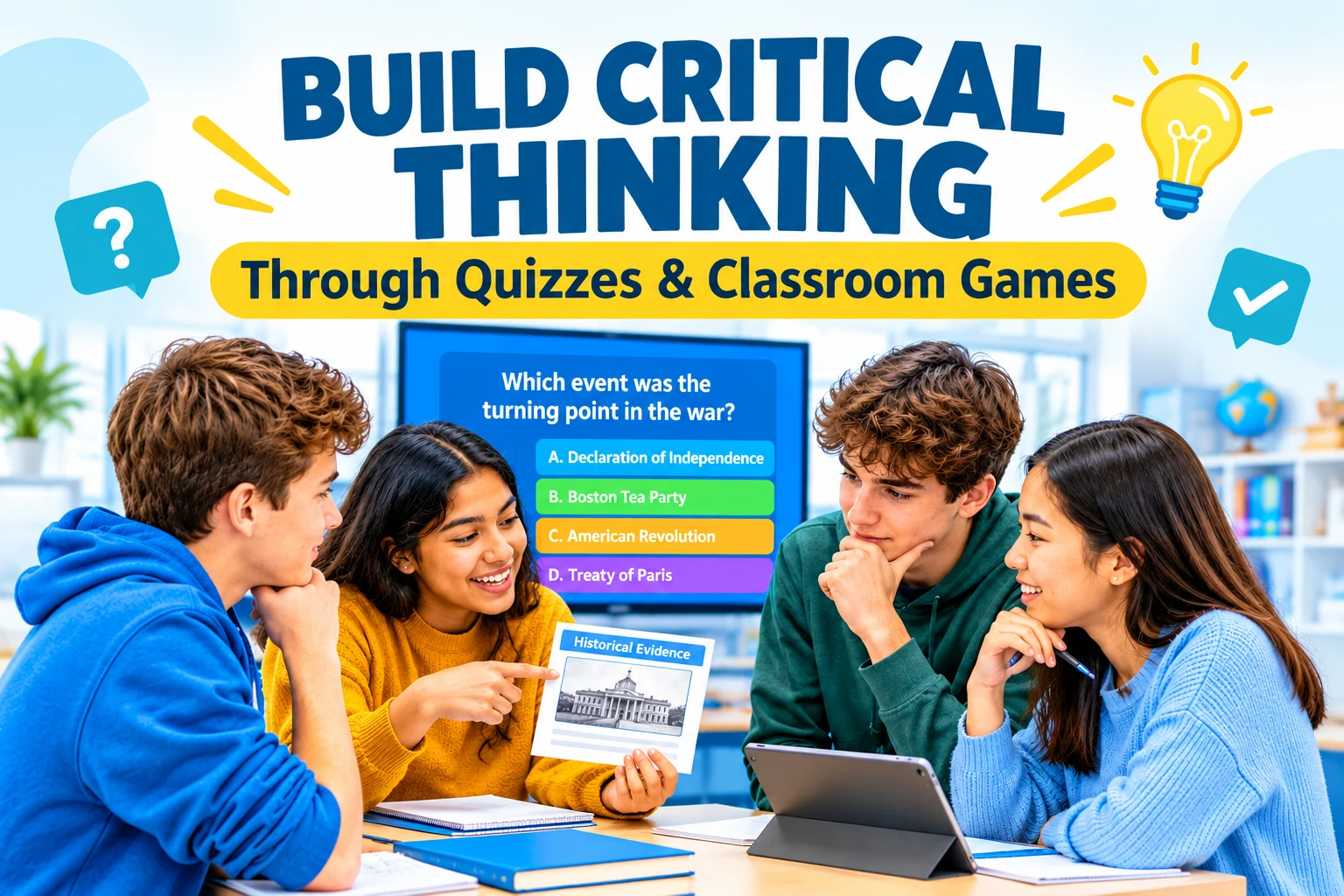
About 10 years ago I spent a week with a high school history teacher in Ohio reviewing the causes of the American Revolution. Her students did a great job of memorizing the several causes of the war in a multiple choice test given at the end of the week. When I asked them one open question — Which cause did they think was least important and why? — silence. Twenty-eight students who had demonstrated good recall of the causes of the war had no idea what to do with them.
Most assessments of history we give measure recall of fact rather than students’ ability to use fact to reach a reasonable conclusion. The only way to make sure that students have learned to reason with the facts that we teach are to include in our lesson plans frequent short assessments that require students to use what they have learned for purposes other than recall.
Teachers can make those short assessments more engaging by turning selected questions into interactive classroom activities. A quiz does not have to stop at checking whether an answer is correct: it can invite students to compare options, explain their choices, and discuss the evidence behind them. For practical ideas, see these interactive classroom games teachers can use.
Why Recall Alone Falls Short
Critical thinking is analyzing information to weigh evidence and identify weaknesses and draw a sound conclusion that can be supported by the information collected. It is a skill and a habit, and can be developed through short, low-stakes activities in class. The activities can repeat often within a lesson, providing far more value than the single large project that often develops poor recall.
Short classroom checks can also work as exit ticket activities, helping teachers identify what students understand before moving on to the next lesson. A quick question followed by a short explanation can reveal much more than a score alone.
According to research done by the researchers at Washington University in St. Louis’ Department of Psychology (retrieval practice), frequent, low-stakes quizzes actually help students learn more and remember longer. But most quizzes are not designed to test students’ ability to judge information; rather, they test to see if students can recall information from memory.
Teachers who want to build a regular practice routine can also explore these self-quizzing study methods. They offer ways to make retrieval practice part of learning before a formal test.
In designing quizzes, rather than simply trying to recall facts, the activities can be set up to test students’ ability to make decisions based on given evidence. For example, the question “When did the war between England and Mexico end?” is a simple recall of facts. However, the question “Of these two sources, which do you think is more accurate? And what evidence did you use to come to that conclusion?” requires the student to make a decision based on their ability to critique given evidence.
One useful approach is to build a quiz around a lesson objective, then include at least one question that asks students to apply or defend an idea. Teachers can create a short digital quiz with TriviaMaker’s quiz maker for teachers and use the answers as a starting point for classroom discussion.
Quiz Formats That Make Students Reason
Just as not every exercise, reading, discussion, or project should be included in lessons, not every quiz is of value to teach students to think critically.
The format should support the thinking skill being practiced. A multiple-choice question can still encourage analysis when its answer options are plausible and students are asked to explain why one is stronger than the others.
Confidence-based quizzes: In these kinds of quizzes, after students have made a guess, they are asked to rate how confident they are in their answer. Because students do not realize that they can be confidently wrong, discussions about why their answer was wrong can be a very powerful learning experience for them.
For a quick classroom round, ask students to choose an answer, record how confident they feel, and then compare their confidence with the evidence. A teacher can revisit the same concept in a later classroom review game to see whether understanding has improved.
Error-hunt questions: Have students read a paragraph, short math problem or short argument and find the error. Students then explain why the error occurred. This type of question helps students become editors and starts to develop the skill that readers and analysts use daily.
Two-answer questions – The teacher offers a question to which two good answers exist. Students select one of the two answers and write one sentence explaining why they chose it. (No trick here.) This activity allows students to practice making a choice and defending it.
These questions work especially well in a team setting: let groups select an answer, then ask a spokesperson to explain the reasoning. A teacher-created classroom game can provide a ready-made starting point for a subject-based activity.
Source-ranking tasks. Students read 4 short extracts on the same topic. They rank them in order of trustworthiness. The key issue here is the reasoning that students use to justify their ranking.
After students rank the sources individually, turn the results into a class discussion. Ask what made one source more reliable, what evidence was missing, and whether anyone changed their ranking after hearing another argument.
Classroom Games With Real Thinking Built In
Most games that you use for review will focus on having students recall information in as short of a time as possible. The focus will be to get students to answer as quickly as possible. Such games teach students to react and not to think.
That does not mean classroom games need to be avoided. It means the teacher should choose questions and rules that reward thoughtful answers, discussion, and evidence—not speed alone. These interactive classroom game ideas can help teachers vary the way students participate.
More thinking, less action, however, is found in role-play situations that allow for slow deliberation. Debate Roulette is a popular class activity where students are assigned to argue a side of a topic, randomly selected by the teacher, including the side they’d normally reject. It encourages students to understand all perspectives of an argument.
This activity is always a favorite, too. Assign small groups the ‘mystery case’ (e.g. a lab scenario or character motives in literature). Provide them with a set of ‘clues’ (some of which are relevant and others misleading). Ask them to come to a conclusion about the ‘mystery’ and explain their reasoning.
A teacher can adapt this into a team quiz by revealing clues one at a time and asking groups to choose the most likely explanation. The important part is the follow-up: students should explain which clues mattered and which ones they rejected.
On the other hand, escape-room style puzzles are great thinking games for classroom activities, as long as the puzzles require real reasoning rather than mere trivia. A puzzle that opens a lock after some clicking by means of a simple memorized fact is merely a nicely-packaged flashcard.
For teachers who want to bring structured game-show energy into review sessions, TriviaMaker offers formats such as Grid, Trivia, Wheel, List, TicTac, Hangman, and Fusion. Teachers can choose a format that suits the activity, create questions around their lesson, and host a live game for the class.
Setting Up A Session That Works
Just a few steps to a great activity.
- Keep it low-stakes. If students know that their grades will depend on their answers to a set of questions then they will stop experimenting at about the 2nd question and begin to try to answer in the ‘right’ way for the rest of the session.
- Ask for the reasoning behind the answers every time. Even correct answers with no explanations are of little value to us.
- Allow wrong answers to be useful. Use them as prompts for class discussion instead of failures.
- Set a time limit: 5-10 minutes is better than a long game that meanders.
For a simple digital session, prepare a small set of questions, choose a game format, and let students join the activity. TriviaMaker allows teachers to create and host classroom quizzes, with students joining through a game code or QR code rather than needing to install an app. Explore the TriviaMaker Classroom Mode to see how structured classroom sessions can be run.
Debrief: It is very important to set aside time at the end of every game for students to describe how they came up with their answers. This is where the most important part of the lesson takes place.
Use the debrief to ask students which clue influenced them, why they ruled out another answer, and whether a classmate’s explanation changed their thinking. The discussion turns a game result into a learning opportunity.
Connecting Games To Writing
Games that teach critical thinking also teach writing. There are many reasons why a student might struggle with essays but none of them have to do with writing. If a student can argue a point in a classroom debate then that student is going to write a very good essay. Most students who struggle with essays have trouble setting up a claim and then supporting that claim with evidence. If someone were to search for write my paper then that individual is struggling with organizing the evidence in order to drive home a particular point of view. Games that teach a student to argue a point orally will give that student the tools to write a very good essay.
Teachers can reinforce the connection by asking students to turn a spoken argument from a game into a short written response. Have them state their claim, select the strongest evidence, and explain how that evidence supports their conclusion.
Purdue OWL can be another useful resource for students. The site includes specific guides for writing arguments as well as using evidence effectively in writing. These can provide students with useful vocabulary for these skills that they can apply to their own writing.
Common Mistakes To Avoid
As with any new pedagogical method, teachers new to the argumentation model tend to make a few mistakes along the way.
The simplest activity is often the best and will ruin the thinking time needed to explore complex issues if it takes too long to set up and explain to the students.
However, don’t make the mistake of rewarding speed over good critical thinking. Using a timer to keep things on track is great, but be sure that the team or student who wins isn’t always the fastest to answer.
Miss the variety of tools available to you. Using the same quiz over and over again can be counterproductive because students learn to the format of the quiz rather than the skill.
Teachers can rotate formats to keep the task fresh: use a category board for comparing topics, multiple-choice rounds for checking understanding, and word-based activities for vocabulary. TriviaMaker’s different game styles make it possible to present quiz content in more than one way.
Fourth, students are frequently judged only on the end product rather than how they arrived at it.
To avoid this, include a simple explanation or evidence requirement in the activity. A correct answer is useful, but the reasoning that led to it is what gives teachers a clearer view of critical-thinking development.
Measuring Progress Without A Big Test
Looking for ways to measure learning without creating a lot of extra work? Pay attention to how your students talk about a topic before and after they engage in a learning game. Students will often move from stating something is true because the book says so to stating that something is true because the evidence supports it. Also, students will often say “I disagree with….” after engaging in learning games that promote critical thinking.
Short digital checks can help teachers notice those changes over time. For more quick assessment ideas, see 25 exit ticket ideas for teachers, including prompts that ask students to explain, apply, and reflect.
Track simple metrics. See how often students cite evidence, challenge a claim, or even change their answer after discussion. Resources from the U.S. Department of Education, the U.S. Department of Education’s resources on instructional practice, help to track other related skills.
Teachers can also compare results from one review session to the next. Classroom review games can provide a repeatable way to revisit key concepts and identify areas that may need more explanation.
Start Small
Start small. Instead of completely overhauling your lessons for the year, change one thing for one lesson this week. Instead of a recall type of question, use a judgment type of question. Add an error hunt of two minutes at the beginning of class. See what happens.
You could begin with a five-question classroom quiz: include a question that checks recall, one that asks students to spot an error, and one that requires them to choose and defend an answer. Build the activity with TriviaMaker’s teacher quiz maker, then use the discussion after each question to explore the reasoning.
The Ohio teacher went back to that same questioning a month later. To her amazement, within the first minute or so of her inquiry, hands were up before she could even complete her query.
Ready to make your next classroom review more interactive? Create a quiz around your next lesson, choose a game style, and invite students to play. Try TriviaMaker and turn your questions into a live classroom game.
Related Articles
- Interactive Classroom Games: 30+ Ideas Teachers Can Use Tomorrow – Explore activities that encourage participation and active learning.
- Classroom Review Games: 10 Test-Prep Strategies for Unit Exams & State Assessments – Find ways to turn review sessions into engaging classroom games.
- 25 Exit Ticket Ideas for Teachers to Check Student Understanding – Use quick checks to identify learning gaps and guide the next lesson.
- 32 Bell Ringer Activities That Take 5 Minutes or Less – Start class with short activities that activate prior knowledge.
- Self-Quizzing Study Methods: 10 Ways to Study Smarter – Help students build stronger independent study habits.
- Quizzes for Exam Preparation: 7 Ways to Boost Student Scores – Use regular quizzes to support preparation and identify weak areas.