
Classroom review games transform passive study guides into active recall sessions – forcing students to pull information from memory under mild pressure. Research by Dunlosky et al. (2013) confirms practice testing (the engine behind every quiz game) has “high utility” for learning, far outperforming re-reading or highlighting.
📌 Looking for icebreakers, bell ringers, or general engagement? This post focuses only on pre-test review, cumulative finals, and state test prep. For the full range of no-tech, digital, and hybrid engagement games, see our comprehensive Interactive Classroom Games guide.
Worksheets don’t work for review. Students re-read their notes, highlight random sentences, and walk into the test thinking they studied. They didn’t. Game-based review solves this by forcing retrieval – and it’s the single most effective way to prepare for high-stakes assessments.
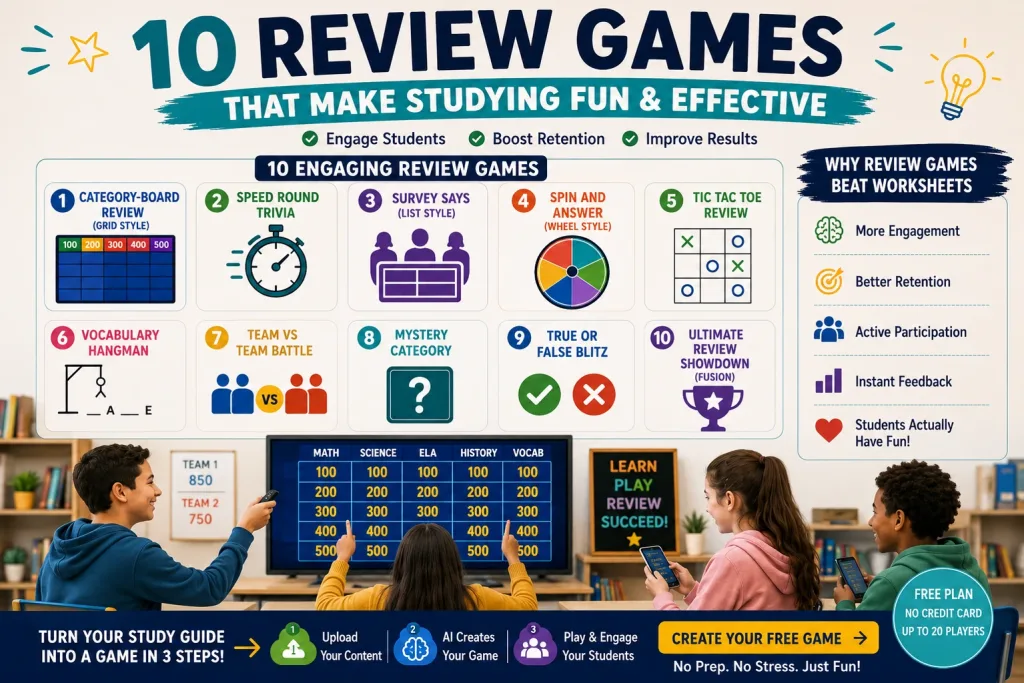
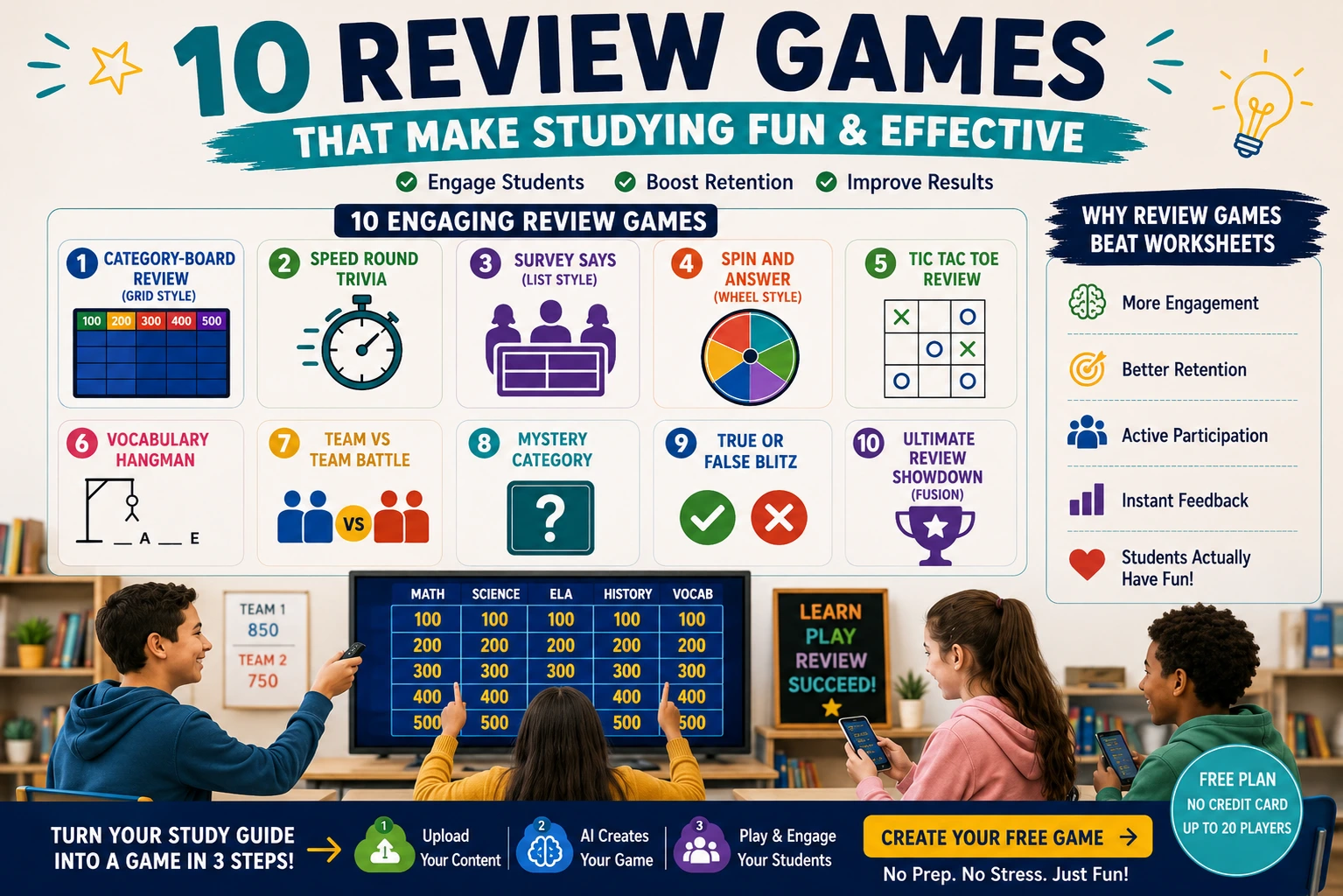
Here are 10 review games that turn any study guide into a live, competitive experience. Each one can be created in TriviaMaker in under 2 minutes – just upload your study guide or type a topic, and AI generates the questions.
Turn Your Unit Study Guide Into a Test-Prep Game in Seconds
Generate cumulative review games with AI. Choose from Trivia, Grid, Tic Tac Toe, Wheel, and more – built specifically for end-of-unit and state exam prep.
Create Your Review Game with AI →Why Review Games Beat Worksheets for Test Prep
The research is unambiguous: students retain more when they actively retrieve information than when they passively re-read it. A meta-analysis by Dunlosky et al. (2013) ranked practice testing as “high utility” – meaning it works across subjects, ages, and test formats. Re-reading and highlighting? “Low utility.”
For a deeper dive into the cognitive science behind active recall, retrieval practice, and why these mechanics beat lectures, visit our full Interactive Classroom Games. Below, we focus strictly on summative test-prep strategies.
How to Create a Review Game in 3 Steps
Step 1: Import your content. Upload a study guide (PDF, DOCX, CSV) or type a topic. TriviaMaker’s AI quiz generator creates questions instantly.
Step 2: Choose a game style. Pick from 7 game styles: Trivia, Grid, List, Wheel, Tic Tac Toe, Hangman, or Fusion.
Step 3: Play. Display on a screen. Students join via QR code – no app download, no student accounts. Real-time leaderboards keep everyone engaged.
Ready to Make Your Next Unit Test Review Unforgettable?
Create interactive review games that turn dread into competition.
The 10 Review Games for Test Prep
1. Category-Board Review (Grid Style) – Best for Cumulative Finals
⏱️ Time: 15–25 minutes
Category-based boards where students choose questions by point value. The most popular review game in American classrooms for a reason – it covers multiple units in one session, making it ideal for semester finals.
How it works: Create 5 categories with 5 questions each (25 total). Students pick a category and point value. Higher points = harder questions.
Sample categories for a History final:
- Key People (100–500 points)
- Critical Dates (100–500 points)
- Causes & Effects (100–500 points)
- Vocabulary (100–500 points)
- Primary Sources (100–500 points)
Best for: History, Science, ELA final exams – any subject with distinct units. Use the Grid style.
2. Speed Round Trivia – Best for State Test Stamina
⏱️ Time: 5–10 minutes
Fast-paced multiple choice with timers. Students race to answer correctly before time runs out. This builds the cognitive stamina needed for standardized tests like the SAT, ACT, or state assessments.
How it works: 15–20 questions, 20–30 seconds each. Students answer on their phones. Leaderboard updates in real time.
Sample questions (Science EOC):
- What is the powerhouse of the cell? – A) Nucleus B) Mitochondria C) Ribosome D) Golgi body
- What gas do plants absorb? – A) Oxygen B) Nitrogen C) Carbon dioxide D) Hydrogen
Best for: Math facts, vocabulary, science terms – subjects with heavy factual recall. Use the Trivia style with 20-second timers.
3. Survey Says (List Style) – Best for Open-Ended Test Sections
⏱️ Time: 10–15 minutes
Students guess the most common answers to survey-style questions. Perfect for reviewing lists of causes, effects, processes, and vocabulary that frequently appear as open-response or essay prompts.
How it works: Show a question. Students guess the top answers. The most common answer scores the most points.
Sample questions:
- “Name a type of figurative language” – Simile (top), Metaphor, Personification, Hyperbole, Alliteration
- “Name a cause of the American Revolution” – Taxation without representation (top), Boston Tea Party, Stamp Act, Quartering Acts
Best for: Science processes, historical causes, grammar rules. Use the List style.
4. Spin and Answer (Wheel Style) – Best for Mixed-Unit Review
⏱️ Time: 10–15 minutes
Spin the wheel to land on a random category or point value. Adds excitement and randomness to cumulative review sessions.
How it works: Create a wheel with 6–8 unit categories. Students spin. Where it lands, they answer a question from that unit.
Sample wheel categories:
- Unit 1 – Foundations
- Unit 2 – Key Figures
- Unit 3 – Events
- Unit 4 – Vocabulary
- Bonus Round (Mix)
- Double Points (Cumulative)
Best for: Semester finals, state test prep. Use the Wheel style.
5. Tic Tac Toe Review – Best for Small-Group Test Prep
⏱️ Time: 10–15 minutes
Two teams compete to claim squares by answering questions correctly. Strategic and competitive – students think carefully before choosing squares, making it great for targeted review stations.
How it works: Display a 3×3 grid. Each square has a question. Teams take turns answering. Correct = claim the square. First to get three in a row wins.
Best for: Any subject – works especially well for small group tutoring sessions. Use the Tic Tac Toe style.
⭕ Create a Tic Tac Toe Review →
6. Vocabulary Hangman – Best for Definitions & Spelling on Finals
⏱️ Time: 5–10 minutes
Guess key vocabulary terms letter by letter. Reinforces spelling and vocabulary recognition – critical for definitions-heavy tests.
How it works: Display a word with blanks. Students guess letters. Each wrong guess adds a body part. 10 vocabulary words per round.
Sample words (ELA final):
- Metaphor
- Alliteration
- Personification
- Onomatopoeia
- Hyperbole
Best for: ELA vocabulary, science terms, foreign language finals. Use the Hangman style.
7. Team vs Team Battle – Best for Comprehensive Unit Tests
⏱️ Time: 15–20 minutes
Split the class into teams and run a competitive trivia tournament. Team mode encourages collaboration – students teach each other to win, which is perfect for broad unit review.
How it works: Divide into 2–4 teams. Each team answers the same questions. Team with the highest combined score wins.
Why it works for tests: Students who might not participate alone often contribute in a team setting. The social pressure of letting teammates down motivates effort – directly translating to better exam performance.
Best for: End-of-unit review, exam prep. Use Trivia with team mode enabled.
8. Mystery Category – Best for State Test Prep Surprise
⏱️ Time: 10–15 minutes
Spin to reveal a mystery category. Students have 60 seconds to answer as many questions as possible. Adds surprise to review – mirroring the unpredictability of state assessments.
How it works: Create a wheel with hidden categories (labeled A, B, C, D). Spin to reveal. Then rapid-fire questions from that category.
Best for: Multi-topic review, semester finals, state test prep. Combine with Trivia questions under each category.
9. True or False Blitz – Best for Factual Review
⏱️ Time: 5–8 minutes
Rapid-fire true or false statements. Students must quickly determine fact from fiction. Fast and effective for factual recall sections of any test.
How it works: 20 true/false statements, 10 seconds each. Students answer on their phones. Fastest correct answer scores bonus points.
Sample questions (History state test):
- True or False: The Declaration of Independence was signed in 1776. – True
- True or False: Abraham Lincoln was the 1st President. – False
- True or False: The Louisiana Purchase doubled the size of the US. – True
Best for: Science, history – subjects with many factual claims. Create 20 true/false questions in Trivia style.
10. Ultimate Review Showdown (Fusion) – Best for Final Exam Marathons
⏱️ Time: 20–30 minutes
Combine multiple game styles into one mega-review session. Start with trivia, move to grid, end with a wheel spin. The variety keeps energy high – essential for marathon review sessions before finals.
How it works: Round 1 = Speed Round Trivia (5 min). Round 2 = grid categories (10 min). Round 3 = Wheel spin for bonus points (5 min). Total score determines the winner.
Best for: Final exam review, state test prep, end-of-year review. Use the Fusion style to combine formats.
Best Review Formats by Subject (Test-Prep Focus)
Not sure which game fits your subject’s test structure? Here’s a quick guide for summative assessments.
Math – Unit & State Exams
| Game | Why It Works for Math Tests | Example |
|---|---|---|
| Speed Round Trivia | Forces quick calculation under pressure (SAT/ACT style) | “What is 15% of 200?” |
| Category-board Review | Covers multiple units (Algebra, Geometry, Stats) | Categories: Algebra, Geometry, Statistics |
| True or False Blitz | Tests conceptual understanding & common misconceptions | “True or False: 0 is a prime number” |
Science – End-of-Course (EOC) Exams
| Game | Why It Works for Science Tests | Example |
|---|---|---|
| Survey Says | Reviews processes and lists (frequent in EOC) | “Name a step in the scientific method” |
| Vocabulary Hangman | Reinforces complex terminology | Photosynthesis, Mitosis, Ecosystem |
| Team vs Team Battle | Covers broad content from multiple units | Mix of all unit topics for cumulative exam |
ELA – Final Exams & Standardized Tests
| Game | Why It Works for ELA Tests | Example |
|---|---|---|
| Vocabulary Hangman | Spelling + definition (SAT/ACT vocab prep) | Metaphor, Alliteration, Onomatopoeia |
| Category-board Review | Covers literary elements across genres | Categories: Grammar, Vocabulary, Literary Devices |
| True or False Blitz | Tests grammar rules and conventions | “True or False: A semicolon connects two independent clauses” |
History – State Assessments & AP Exams
| Game | Why It Works for History Tests | Example |
|---|---|---|
| Category-board Review | Organizes units chronologically/thematically | Categories: People, Dates, Causes, Vocabulary |
| Survey Says | Reviews causes and effects (AP FRQ prep) | “Name a cause of World War I” |
| Speed Round Trivia | Quick fact recall for multiple-choice sections | “What year did WWI begin?” |
Foreign Language – Vocabulary & Grammar Finals
| Game | Why It Works for Language Tests | Example |
|---|---|---|
| Vocabulary Hangman | Spelling in target language | Spanish vocabulary words |
| Speed Round Trivia | Quick translation recall | “What does ‘biblioteca’ mean?” |
| Tic Tac Toe Review | Grammar practice (conjugations) | Conjugation questions for final exam |
Review Games by Grade Level (Test-Prep Pacing)
Elementary (K–5) – Unit Tests
- Keep review rounds short (5–8 minutes max) to match attention spans
- Use 10 questions instead of 20 to avoid fatigue
- Incorporate picture-based questions for visual recall
- Focus on participation and confidence-building, not just correct answers
- Use Trivia style with simple multiple-choice options
Middle School (6–8) – Quarter & Semester Finals
- 10–12 minute games are the sweet spot for retention
- Mix individual and team formats to build test-taking confidence
- Use leaderboards to simulate the pressure of timed exams
- Rotate game styles to prevent boredom during review week
- Use Grid style for comprehensive unit coverage
High School (9–12) – AP, SAT, ACT & State Exams
- 15–20 minute games to build endurance for long exams
- Format questions to mirror standardized tests (SAT, ACT, AP)
- Use team mode for collaborative problem-solving (AP FRQ prep)
- Connect review to test-taking strategies (time management, process of elimination)
- Use Fusion style for multi-format marathon review sessions
When to Use Review Games (Test-Prep Timeline)
| Timing | Game Type | Why It Works |
|---|---|---|
| 2–3 days before a unit test | Grid or Team Battle | Covers all topics in one engaging session |
| 1 week before midterms | Fusion (multi-format) | Keeps energy high across a long review block |
| 2 weeks before state tests | Speed Round Trivia | Builds test-taking speed and mental stamina |
| Last 5 minutes of review day | True or False Blitz | Quick wrap-up that reinforces key facts |
| End of semester | Ultimate Review Showdown | Comprehensive review that feels like a celebration |
| Week before finals | Mystery Category | Covers everything with an element of surprise |
Common Review Game Mistakes (Test-Prep Edition)
Playing without reviewing answers. The game is the review, but you still need to discuss the answers. After each question, spend 15 seconds explaining why the answer is correct. That’s where the learning happens.
Grading the game. Review games should be low-stakes. If students are worried about grades, they’ll play it safe instead of taking risks. Use the game for practice, not assessment.
Only using one game style. Students get bored of Category-board if you play it every time. Rotate between the 10 games above. Variety keeps engagement high.
Making it too long. A 45-minute review game loses steam after 20 minutes. Keep it short and end on a high note. Students should want more, not less.
Not connecting to the test. After the game, remind students: “Notice that most of you missed the questions about [topic]. That will be on the test. Let’s review that now.”
Skipping the debrief. Show the leaderboard. Celebrate the winners. Discuss common mistakes. The 2-minute debrief after the game is as important as the game itself.
Read more: Common mistakes teachers make when designing quizzes →
Review Games vs. Worksheets: The Research
| Review Games | Worksheets | |
|---|---|---|
| Learning strategy | Active recall (high utility per Dunlosky) | Passive re-reading (low utility per Dunlosky) |
| Engagement | High – competitive, social | Low – isolated, repetitive |
| Feedback | Immediate – students see mistakes right away | Delayed – teacher grades later |
| Time efficiency | 10–15 minutes covers 20+ questions | 20–30 minutes for 10 questions |
| Student preference | Strongly preferred | Tolerated, not enjoyed |
| Research support | Dunlosky et al. (2013): “high utility” | Dunlosky et al. (2013): “low utility” |
The bottom line: If your goal is for students to remember the material on test day, active recall through games beats passive review every time. The research is unambiguous.
Dunlosky et al. (2013) – Full research paper →
Frequently Asked Questions (Test-Prep Focus)
What are the best review games for test prep?
The most effective review games for exams use active recall – pulling information out of memory instead of re-reading it. For unit tests, use Grid or Team Battle. For state test stamina, use Speed Round Trivia. For cumulative finals, use Fusion. All can be created in TriviaMaker in under 2 minutes.
How do I make test review fun without losing focus?
Use game-based review instead of worksheets. Games add timers, leaderboards, and competition – which make students care about their score. TriviaMaker lets you upload any study guide and AI creates the game automatically. Keep sessions under 20 minutes to maintain focus.
Are review games effective for state test prep?
Yes. Research by Dunlosky et al. (2013) found that practice testing (active recall) is one of the most effective learning strategies – far more effective than re-reading, highlighting, or summarizing. Game-based review is practice testing in a fun, low-stakes format that directly translates to test-day performance.
How long should a review game last before a test?
10–15 minutes for most unit reviews. Elementary students: 5–10 minutes. High school students: 15–20 minutes (to build endurance for long exams). If a game goes past 20 minutes, energy drops. Keep it short and end on a high note.
Can I use review games for remote test prep?
Yes. TriviaMaker works on any device with a browser. Share the game code in the chat. Students join from home on their phones or laptops. The experience is identical to in-person – perfect for hybrid exam prep.
What’s the difference between a review game and a bell ringer?
Bell ringers are daily 3–5 minute warm-ups at the start of class. Review games are 10–20 minute sessions specifically designed for unit tests, semester finals, and state assessments. Bell ringers reinforce yesterday’s material. Review games cover an entire unit cumulatively.
What’s the best review game for a final exam?
The Ultimate Review Showdown (Fusion) is best for finals. It combines Speed Round Trivia, Grid Categories, and a bonus Wheel spin – keeping energy high across a 20–30 minute block while covering every unit from the semester.
Can AI generate test-prep questions automatically?
Yes. TriviaMaker’s AI Quiz Maker can turn your study guide, notes, or uploaded document into a full set of playable questions in under 60 seconds – then you review and edit before launching. This is the fastest way to build standards-aligned test prep.
Related Reads
- Start here: Interactive Classroom Games) – Full guide covering icebreakers, bell ringers, and engagement formats.
- 20 Back to School Night Ideas That Actually Get Parents Engaged – interactive activities and icebreakers for parent events.
- 50+ All About Me Questions – ready-to-use prompts by age group, plus a 5-minute quiz template.
- 25 All About Me Activities That Actually Engage Students – game-style alternatives to the classic worksheet.
- 32 Bell Ringer Activities – ideas and ready-made templates you can load into any game style in minutes.
Turn Your Study Guide Into a Test-Prep Game
You don’t need to spend an hour making a Category-board in PowerPoint. You don’t need to write 50 questions by hand.
Upload your study guide. AI creates the game. Share the code. Start playing.
That’s it. Your students just reviewed for the test – and they actually enjoyed it.
Free to start. The free plan supports 20 students. If your class is larger or you want AI-generated questions from any topic, Premium is $6.99/month. Enterprise plans available for schools.
Ready to Make Every Unit Review More Engaging? 🚀
Create test-prep review games in minutes with AI. Choose from Trivia, Grid, Tic Tac Toe, Wheel, and more – all built for cumulative exams and state assessments.
Create Your Free Review Game
Free plan • No credit card • Up to 20 players
Last updated July 2026. All review games can be created free at TriviaMaker.com.