
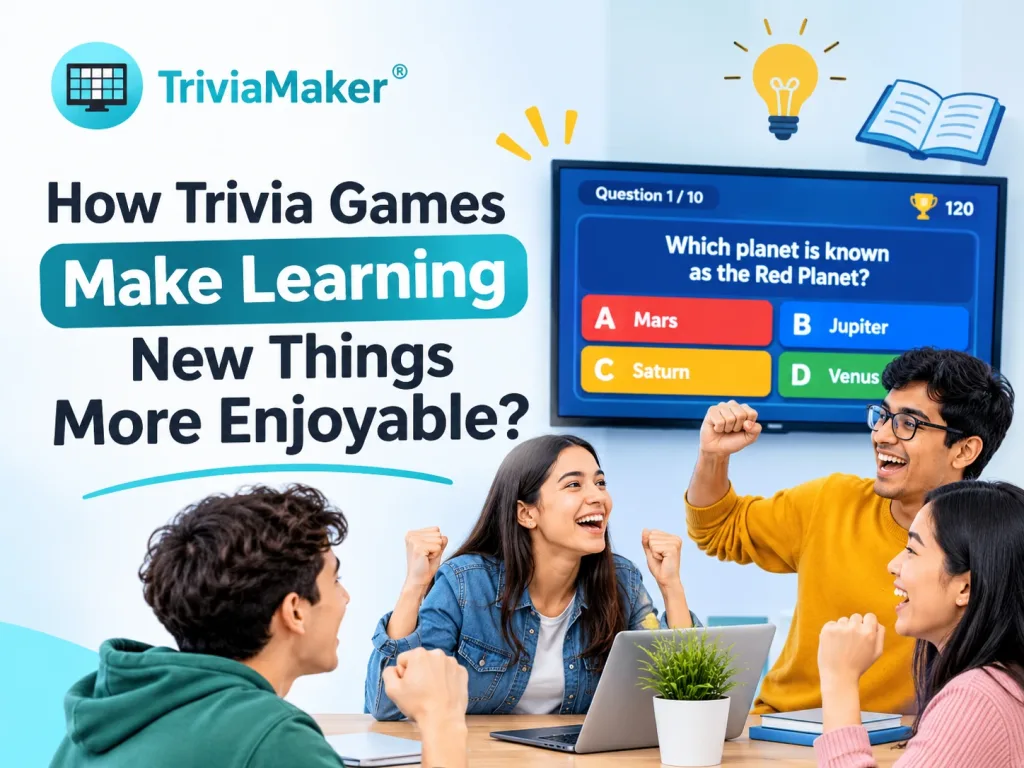

No one’s excited when they learn a set of facts. Now ask a group of people who painted the Mona Lisa and hands will rise to their feet. Somebody says something he or she has guessed, all wrong but with whole-hearted confidence. Everyone laughs. This little spark is what makes trivia games persist from pubs to phones and people will happily acquire new information without even realizing that they are learning.

Why Curiosity Makes Facts Stick
It’s important to understand that a question creates a gap that a plain statement doesn’t. Gaps of any kind in the brain are not acceptable: if there is a gap, the brain rushes to fill it. In a 2014 study, Matthias Gruber, of the University of California, Davis, found that those who were curious about a question remembered the answer to it more easily. If they saw faces which they didn’t see the whole time, but only looked at briefly such as as they waited for an answer, then this stayed with them more frequently. However, curiosity, in effect, serves as a memory booster.
The boost is activated in trivia games, round by round. Every question is a little enigma. The answer is not given to you, you chase it. As it finally arrives, it will come with a jolt—a surprise or a satisfaction—this jolt is what cements a fact in place for later.
Testing Yourself Beats Rereading
This is a number to remember. In an iconic 2006 study conducted by Henry Roediger and Jeffrey Karpicke, students who practiced recalling a text recalled approximately 61 percent of it a week later. Those who reread it alone recalled about 40 percent. Same material. Same time. Very different results.
Retrieval practice in a party hat – a trivia round. You are able to retrieve from your own mind rather than memorize. Feeling like play, the effort does not feel heavy, but your brain is still doing the hard work that is required to learn something that lasts. Results from elementary schools to universities have been reported later in the classroom and those benefits have been similar.
Make Retrieval Practice Feel Like Play
Stop re-reading and start playing. Turn any topic into a live, interactive quiz that helps students and teams remember 61% more.
Create Your First Game FreeNo credit card required · Play up to 20 people for free
Digital Platforms Bring Trivia Games Everywhere
Apps and websites changed the game completely. Today you can join a live quiz on your phone during a lunch break, challenge a friend in another country, or take on a thousand strangers in a themed tournament. Most platforms ask you to create an account, enter an email address, and sometimes link a payment card.
That is why a small security habit goes a long way. Public Wi-Fi in a café or an airport is convenient, but it is also an easy place for snoops to watch network traffic. Using a VPN such as VeePN encrypts your connection and hides your real IP address, so your quiz sessions and login details stay away from prying eyes. Play smart, stay private, and the only thing at risk is your pride on the leaderboard.
A digital quiz also offers some additional features that a paper quiz can’t. Instant scoring. Timers who increase pressure to the right level. Who doesn’t love a friendly competition? The questions are from the vast database of trivia questions and so you can have anything from volcano science to cartoons from the 1990s.
What Makes Trivia Different From Ordinary Study
Studying the traditional way can be cumbersome. The mood is turned upside down with trivia. What is different:
- Low pressure. If you answer incorrectly, you lose a point NOT a grade.
- Instant feedback. The correct answer appears before your eyes when the question is new to you.
- Constant variety. Boredom doesn’t get a seat because topics change from round to round.
- Shared energy. Laughter and a friendly competition link facts to real memories.
Low Pressure. High Engagement.
Turn your next lesson or team meeting into a game show. Create custom quizzes in minutes and let players join from their phones.
Explore Game ModesShort Rounds, Longer Memory
One trivia question takes seconds. Well, that seems like nothing, but it counts. Short sessions can be repeated and are better if they are practiced on several days rather than the night before. This is because back in the 1880s Hermann Ebbinghaus discovered that new information is lost quickly if it isn’t revisited. Playing a couple of minutes of a quiz daily is a fun way to achieve that.
Just as you water a plant. The roots are drowned once a month by one big flood. Just a bit of water daily will sustain all life. You don’t call it homework, you call it trivia and it’s like that every day.
Points, Streaks, and the Motivation Boost
The perception of gamification as a gimmick isn’t entirely fair, but the figures are more positive. In the meta analysis of Michael Sailer and Lisa Homer in 2020, the effect size of game elements on cognitive learning outcomes was around 0.5, indicating a moderate positive effect. Points, levels and streaks don’t come from magic. They just provide a tangible incentive for effort.
All of these features are built into trivia games with the right game modes. Participate in a leaderboard, maintain a streak of 10 days, or improve your own record from today. Those who never read a geography book will willingly spend an hour with a map if there’s a score involved.
Boost Motivation with Live Scoreboards
Our 7 unique game styles — including Grid, Wheel, and Tic-Tac-Toe — make learning addictive. See which one fits your next session.
Explore 7 Game StylesWrong Answers Are Part of the Fun
Errors don’t sting as much in a game. If the guess is incorrect, the room moans, then laughs. This emotional moment helps. The hypercorrection effect (Brady Butterfield and Janet Metcalfe, 2001) indicates that when people are certain about their incorrect response, they are more likely to correct and remember it.
The result is that any mistake becomes a weight around your neck. Anyone who ever said that Sydney is the capital of Australia won’t forget that it is Canberra. The embarrassment was short-lived. The fact stays.
Learning Together Feels Better
Trivia is not a game of one. Families sit around the dinner table playing games, friends gather in groups to play games, teachers run fast quiz rounds before a class. Relational skills involving teammates: discussing, negotiating, and stating reasons aloud. One of the best ways to learn about an idea is to try to explain it to someone else.
“Tell me and I forget. Teach me and I may remember. Involve me and I learn.”
— a saying often credited to Benjamin Franklin, though its true origin is debated
How to Turn Trivia Into a Learning Habit
You don’t need a strict plan, but a loose one helps:
- Pick a topic you actually like, whether it’s space, food history, or football records — start from a ready-made set of general knowledge questions and answers if you are not sure where to begin.
- Play five to ten minutes a day instead of one long session.
- Jot down the questions you missed.
- Replay those questions a week later.
- Invite a friend. A little competition keeps the habit alive.
Final Thoughts: Play Your Way Smarter
Learning does not have to feel like homework. Trivia games prove it. They use curiosity, quick feedback, friendly competition, and a dash of laughter to make knowledge stick. Whether you play on a phone, at a pub, or around the kitchen table, every round quietly trains your memory. So grab a question, take a guess, and enjoy being wrong now and then. That is often where the best learning begins.
Ready to Turn Trivia Into Your New Learning Habit?
Join thousands of teachers, trainers, and hosts who use TriviaMaker to make knowledge stick. Build your first live game in under 5 minutes.
Start Playing for FreeFree forever plan · No credit card required