
The first week of school is a beautiful, chaotic blur. You’ve spent weeks laminating decorations, perfecting your seating charts, and losing sleep over one burning question: How am I going to turn this room full of quiet, nervous strangers into a connected community? You want real engagement. But by day three, exhaustion sets in, your prep period is slipping away, and you resort to the old reliable: the classic “All About Me” worksheet. You hand it out, hoping for magic. Instead, twenty-five kids sit in absolute silence, dragging a golf pencil across the page to write their favorite color and what they ate for summer vacation. You watch them turn it in, realizing nobody laughed, nobody made a friend, and you’re left with a stack of papers heading straight for the recycling bin by Friday. It feels like a wasted opportunity to truly connect.
But it’s not your fault – traditional icebreakers just aren’t built for modern classrooms. Here’s the fix: turn “get to know you” into a live game everyone plays at the same time, right from their seats.
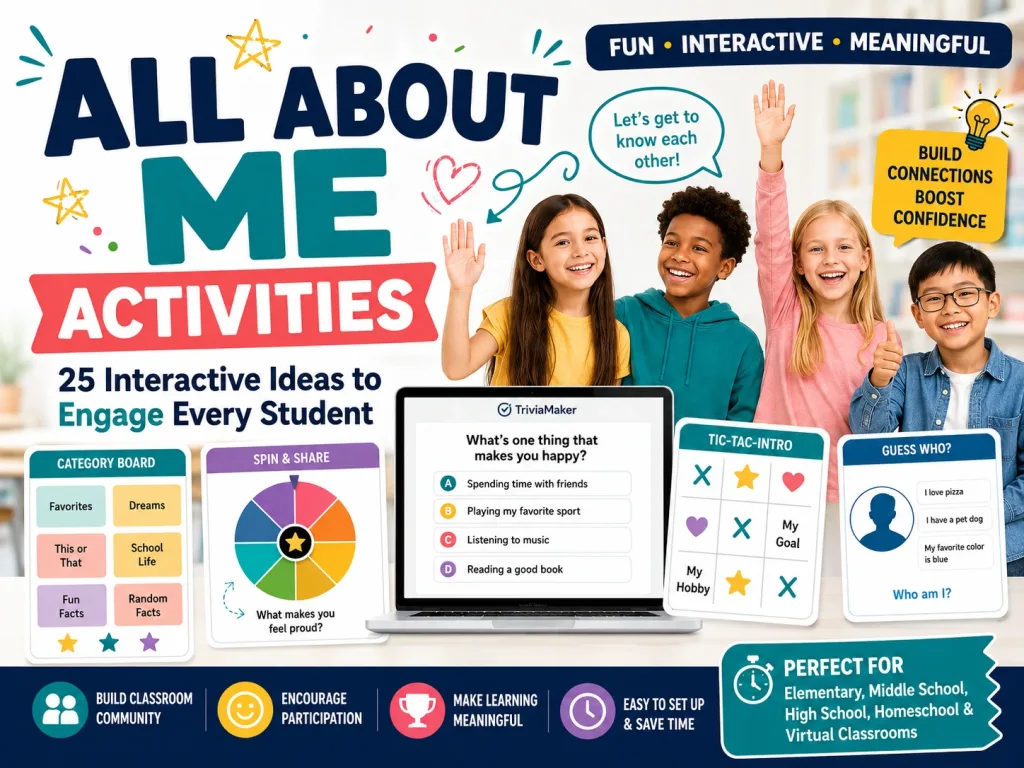
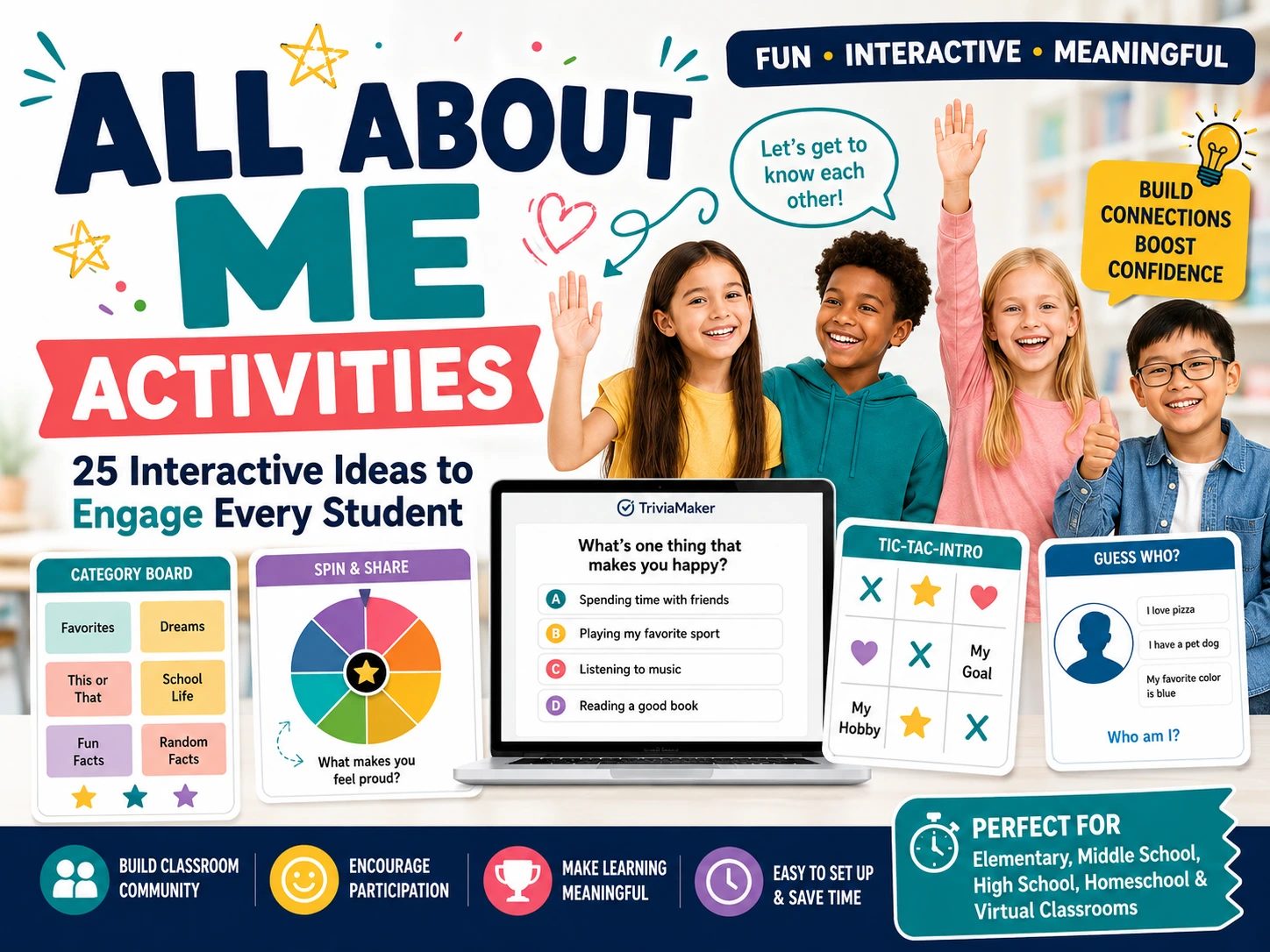
That’s exactly why we built TriviaMaker. Instead of isolating students with a piece of paper, TriviaMaker lets you turn student facts, summer stories, and hobbies into interactive, game-show-style quizzes. With 7 different game styles, no student sign-ins required, and support for virtually any device (or your classroom display), it transforms a passive task into a memorable shared experience. When students are racing the clock, cheering for their teams, and guessing fun facts about the classmate sitting next to them, they aren’t just filling out a form – they’re building a community.
Below are 25 interactive “All About Me” activities, organized by game style, that you can launch in your classroom tomorrow morning.
Don’t have student prompts ready yet? Start with our All About Me Questions, then turn the answers into any of the interactive activities below.
Why Traditional ‘All About Me’ Activities Fail
You know what I mean when you picture that stack of worksheets in the recycling bin by September. Here’s why the classic version never sticks:
- Isolation: Students work alone, heads down, filling in blanks. Nothing about that builds community – it’s independent seatwork wearing a friendly title.
- Low stakes: There’s no reason to pay attention, no competition, no reveal. A worksheet can’t create excitement because nothing is actually happening.
- Forgettable: Ask a student on day three what they learned about their table partner on day one. They won’t remember, because nothing about writing “I like pizza” on a page creates a memory.
The Interactive Solution – Powered by TriviaMaker
TriviaMaker transforms traditional “All About Me” activities into interactive classroom games. With 7 game styles, no student sign-ins, and support for phones, tablets, laptops, and classroom displays, you can get every student participating from the very first day. It’s built specifically for teachers who want simple, engaging classroom activities.
Whether you prefer a category board, multiple-choice quiz, survey game, spinning wheel, tic-tac-toe challenge, or hangman, the activities below show exactly how to adapt each game style for your classroom.
25 ‘All About Me’ Activities for Every Classroom
Grid-Style Activities (Category Board)
1. Category Board Bio
Each category on the board represents one slice of a student’s life – Family, Hobbies, Summer, and Dream Job. Teams pick a category and point value, then answer a question built from a classmate’s real submission. The harder the question, the more points it’s worth.
Best for: 3-5
How to Run This Activity:
Step 1: Collect one fact per category from each student beforehand, using an index card or quick form.
Step 2: Group facts into four to six categories with increasing difficulty levels.
Step 3: Build a Grid game with categories like “Summer Memories” and “Fun Facts,” assigning higher point values to harder facts.
Step 4: Split the class into teams and let them pick a category and value each round – reveal whose fact it is after every correct guess.
Need more ideas for student responses? Try our All About Me Questions to collect fun facts before your next class.
2. Teacher Trivia Board
Flip the format – this time, the board is all about you. Students compete in teams to see who knows the most about their teacher by the end of round one. Categories can include “Childhood,” “Hobbies,” and “Weird Facts.”
Best for: K-2
How to Run This Activity:
Step 1: Write down 15-20 facts about yourself, from pets to hobbies to your first job.
Step 2: Sort them into categories like “Childhood,” “Hobbies,” and “Weird Facts.”
Step 3: Load them into a Grid game with point values per row.
Step 4: Let teams choose categories and values, and celebrate loudly when someone nails a hard one.
3. Classroom Rules Grid
Blend community-building with classroom management. Students earn points for correctly matching classroom expectations to categories like “Respect,” “Safety,” and “Responsibility” – while getting to know how their classmates think.
Best for: K-5
How to Run This Activity:
Step 1: List your top classroom expectations.
Step 2: Sort them into three or four categories.
Step 3: Set up a Grid board where each square is a scenario question – for example, “You forgot a pencil, what do you do?” – with increasing point values for more thoughtful answers.
Step 4: Discuss answers as a group after each reveal to build shared understanding, not just points.
4. Hometown Heroes Grid
Great for classes with students from different neighborhoods, states, or countries. Categories cover food, traditions, and local landmarks, giving every student a reason to be the “expert” for a round.
Best for: 6-8
How to Run This Activity:
Step 1: Ask students to submit one fact about where they’re from.
Step 2: Group answers into categories like “Food,” “Language,” and “Traditions.”
Step 3: Build the Grid game and assign harder facts higher point values – the more obscure the fact, the more it’s worth.
Step 4: After each answer is revealed, let the student behind it add one extra sentence to the class.
Turn These Ideas Into a Grid Game →
List-Style Activities (Survey-Style)
5. Top Answers: Our Class Edition
Ask a broad question like “Name something you’d bring to a desert island,” then reveal the class’s most popular answers one at a time – Survey style. Students guess before they see the ranking.
Best for: All
How to Run This Activity:
Step 1: Pick three to five open-ended prompts.
Step 2: Collect quick answers from the whole class, either live or ahead of time.
Step 3: Try the List style for survey-style answers, ranking the most common responses from most to least popular.
Step 4: Let teams guess the top three answers before revealing the full ranked list.
6. Guess the Grade-Level Favorite
Instead of guessing individuals, students guess what their whole grade level thinks is the best lunch, subject, or recess game – building a sense of shared identity beyond just one classroom.
Best for: 6-8
How to Run This Activity:
Step 1: Survey a few classes at the same grade level ahead of time, on paper or digitally.
Step 2: Compile the top answers per question.
Step 3: Load the ranked results into a List-style game.
Step 4: Play as a whole grade if possible, or run it class by class and compare guesses afterward.
7. Most Likely To…
A gentle, teacher-curated version of the classic superlative game. Students guess which pre-selected traits the class voted as most common – no individual names attached, keeping it low-pressure and kind.
Best for: 9-12
How to Run This Activity:
Step 1: Write positive, inclusive prompts like “Most likely to help a friend” or “Most likely to try something new.”
Step 2: Have students vote anonymously on general traits, not classmates.
Step 3: Build a List-style game showing the ranked class results.
Step 4: Reveal answers together and talk about what makes your class unique as a group.
8. Summer Survey Showdown
A first-day classic reimagined: instead of writing about summer alone, students guess the top summer activities their new classmates actually did.
Best for: K-5
How to Run This Activity:
Step 1: Ask a simple prompt: “What did you do this summer?” collected as students walk in.
Step 2: Tally the most common categories – travel, sports, family time, screen time.
Step 3: Enter the ranked list into a List-style game.
Step 4: Let teams guess the order before revealing, then ask a few students to share details behind the top answer.
Trivia-Style Activities (Multiple Choice)
9. Who Said It?
Anonymous quotes from student surveys are read aloud, and the whole class picks who they think said it from a multiple-choice list of classmates. Fast-paced and revealing.
Best for: 6-8
How to Run This Activity:
Step 1: Collect a fun, anonymous fact or opinion from each student.
Step 2: Turn each fact into a multiple-choice question with three or four possible classmates as answer options.
Step 3: Create a Trivia-style game with each fact as its own question.
Step 4: Reveal the correct answer after each vote and let the student confirm or share more.
10. Two Truths and a Trivia Twist
The icebreaker classic, but instead of a live guessing circle, every student’s “two truths and a lie” becomes a multiple-choice question the whole class answers at once. Way more engagement than the circle version.
Best for: 9-12
How to Run This Activity:
Step 1: Have each student write two true facts and one false one.
Step 2: Turn each set into a three-option multiple-choice question.
Step 3: Build a Trivia-style game with one question per student – use the AI generator to speed up formatting if needed.
Step 4: Reveal the lie after each round and let the student explain the real story behind the truths.
Stop Wasting Time on Boring Worksheets
No credit card required. Start building now.
11. Class Roster Trivia
A pure name-and-face-learning game. Multiple-choice questions test who remembers who, using simple facts each student shared earlier in the day.
Best for: K-2
How to Run This Activity:
Step 1: After introductions, jot down one memorable fact per student.
Step 2: Write multiple-choice questions like “Who has three siblings?” with classmates as the options.
Step 3: Build the Trivia-style game and play it right after introductions while facts are still fresh.
Step 4: Celebrate whoever ends the round with the most correct matches.
12. Would You Rather: Class Edition
Classic “Would You Rather” prompts, played as live multiple-choice trivia so the whole class can see results and reactions instantly.
Best for: All
How to Run This Activity:
Step 1: Write 10-15 fun “Would You Rather” prompts appropriate for your grade level.
Step 2: Format each as a two-option multiple-choice question.
Step 3: Build the Trivia-style game so results show live after each vote.
Step 4: Pause after surprising splits and ask a few students why they chose their answer.
Turn These Activities Into a Trivia Quiz →
Wheel-Style Activities (Spin for Values + Guess Letters)
In TriviaMaker’s Wheel style, players spin a wheel to determine a dollar value for each letter they guess correctly – just like the classic game show. Students work together or in teams to guess hidden phrases, names, or answers one letter at a time.
13. Spin & Solve: Classmate Name
A classmate’s full name is hidden as a puzzle. Students spin the wheel to land on a dollar value, then guess a letter. Correct guesses earn the value – wrong guesses lose a turn. The first team to solve the name wins the round.
Best for: K-5
How to Run This Activity:
Step 1: Select 5-10 student names to feature.
Step 2: Set each full name as a hidden phrase in a Wheel-style game.
Step 3: Students spin the wheel to land on a dollar amount (e.g., $100, $200, $500) – guess a consonant to earn that value, or buy a vowel for a set price.
Step 4: The team that solves the puzzle keeps the accumulated points. Rotate featured names each round so everyone gets a turn in the spotlight.
14. Wheel of Fun Facts
Each round features a hidden fun fact about a student. Teams spin for values, guess letters, and solve the phrase to discover who the fact belongs to. Combines the thrill of the wheel with getting-to-know-you content.
Best for: 3-8
How to Run This Activity:
Step 1: Collect anonymous fun facts from students (e.g., “Has a pet iguana,” “Visited 5 countries”).
Step 2: Turn each fact into a hidden phrase puzzle (remove spaces, show blanks).
Step 3: Load the puzzles into a Wheel-style game with dollar values assigned to wheel segments.
Step 4: Teams spin, guess letters, solve the puzzle, then reveal which student the fact belongs to.
15. Dream Job Wheel
Hidden career titles are the puzzles. Students spin for values and guess letters to reveal different dream jobs submitted by their classmates. Once solved, the class guesses who wants that career.
Best for: 6-12
How to Run This Activity:
Step 1: Have each student write their dream job on an index card.
Step 2: Load a selection of these job titles as hidden puzzles in the Wheel game.
Step 3: Teams spin to land on values, guess consonants to earn points, and buy vowels as needed.
Step 4: After solving, reveal which student submitted that dream job and let them share why.
16. Class Superlative Wheel
Hidden superlative phrases (e.g., “Most Likely To Brighten Your Day”) are solved letter by letter. Teams spin for values, guess letters, and race to solve the puzzle first. The solved phrase becomes a category for nominating classmates.
Best for: 9-12
How to Run This Activity:
Step 1: Write 8-10 positive superlative phrases.
Step 2: Load each phrase as a hidden puzzle in the Wheel game.
Step 3: Teams spin for dollar values and guess letters to earn points.
Step 4: Once a phrase is solved, the class nominates someone who fits that description – celebrating classmates in a fun, low-pressure way.
17. Spin to Reveal: Summer Recap
Hidden phrases describe summer activities (e.g., “Went to the beach,” “Learned to cook”). Teams spin for values, guess letters, and solve the puzzles. After each reveal, students raise their hands if they did that activity too.
Best for: K-8
How to Run This Activity:
Step 1: Collect summer activity descriptions from students.
Step 2: Turn the most common ones into hidden phrase puzzles.
Step 3: Load them into a Wheel-style game with value segments.
Step 4: Teams spin, guess letters, and solve. After each reveal, ask the class who did that activity – builds instant common ground.
Tic-Tac-Style Activities (Strategic Play)
18. Fact Board Face-Off
Two teams battle for board squares by answering personal-fact questions correctly. Because it’s a strategy game, students have to keep thinking about the board even during the other team’s turn – it’s not just about answering, it’s about planning ahead.
Best for: 6-8
How to Run This Activity:
Step 1: Collect a handful of light personal-fact questions from students.
Step 2: Split the class into two teams.
Step 3: Build a Tic-Tac-style game where each correct answer claims a square on the board.
Step 4: Play multiple rounds so every student gets at least one turn to answer and plan their team’s next move.
19. Get-to-Know-You Grid Battle
Pairs of students go head-to-head answering questions about the class as a whole, forcing them to plan their next move while paying attention to every answer given. Strategic thinking meets community building.
Best for: 9-12
How to Run This Activity:
Step 1: Write general “about our class” questions, like favorite subject or most common pet.
Step 2: Pair students into head-to-head match-ups.
Step 3: Load the questions into a Tic-Tac-style game and let pairs compete for squares.
Step 4: Rotate pairs after each round so everyone plays a few matches and thinks strategically about each move.
20. Table Team Tic-Tac
Turn seating groups into competing teams for a full-class version of Tic-Tac using questions built entirely from student intro cards collected that morning.
Best for: 3-5
How to Run This Activity:
Step 1: Collect a quick intro card from every table group as students arrive.
Step 2: Pull out five or six questions per table’s facts.
Step 3: Build one Tic-Tac-style game per table group, or run one big class version.
Step 4: Let each table take turns answering to claim their square, projecting the board on the screen so it feels like a real event – students must think ahead to block the other teams.
Create Your Own Tic-Tac Game →
Hangman-Style Activities (Vocabulary & Word Guessing)
21. Guess My Hobby
A student submits their favorite hobby as the hidden word, and the class guesses letter by letter while the student gives clues along the way. Builds vocabulary and spelling skills while learning about classmates.
Best for: K-5
How to Run This Activity:
Step 1: Ask each student to write down one hobby or interest as a single word or short phrase.
Step 2: For a literacy and vocabulary twist, learn how to create your own Hangman-style word game using those submissions.
Step 3: Load one hobby per round, letting the class guess letters together – perfect for reinforcing spelling.
Step 4: Once solved, have the student share why they love that hobby.
22. Mystery Classmate Name
Instead of a word, the hidden answer is a classmate’s name, revealed one letter at a time alongside a fun fact clue after every guess. Great for name recognition and early literacy skills.
Best for: K-2
How to Run This Activity:
Step 1: Pick a few students to feature and gather one fun fact each.
Step 2: Set each student’s first name as the Hangman answer.
Step 3: Reveal one bonus fact clue for every wrong guess to help without making it too easy.
Step 4: Celebrate the reveal and let that student add one more fact to the group.
23. Dream Job Decoder
Students submit their dream job as a hidden word puzzle, giving older students a chance to talk about future goals while practicing spelling and vocabulary in a familiar game format.
Best for: 9-12
How to Run This Activity:
Step 1: Have each student write their current dream job on an index card.
Step 2: Load a handful of the more unique answers as separate Hangman rounds.
Step 3: Play as a class, guessing letters together until the job title is solved – great for career vocabulary exposure.
Step 4: Ask the student behind each answer what sparked their interest in that career.
Turn These Ideas Into a Hangman Game →
Fusion-Style Activities (Mixed Formats)
24. The Ultimate Get-to-Know-You Marathon
A full-period, multi-round session that opens with a Wheel round (spin for values + guess letters), moves into Trivia to test what the class remembers, and wraps with a Grid round for team points. Keeps energy high across a longer event.
Best for: All
How to Run This Activity:
Step 1: Collect a short bio fact set from every student ahead of time.
Step 2: Build a Fusion game that opens with a Wheel round featuring student names as puzzles.
Step 3: Follow with a Trivia round testing recall of facts already shared, then close with a Grid round for team scoring.
Step 4: Save 15-20 minutes for this – it’s meant to be the centerpiece activity of your first day.
25. Icebreaker Triathlon
Three quick rounds – List, Tic-Tac, and Hangman – keep the pace fast and give every learning style a moment to shine, whether they love guessing, strategy, or word puzzles. Fusion makes this seamless.
Best for: 6-8
How to Run This Activity:
Step 1: Prepare three small question sets, one for each format.
Step 2: Build a Fusion game combining a List round, a Tic-Tac round, and a Hangman round back to back.
Step 3: Keep each round to five minutes so the whole activity fits in fifteen.
Step 4: Track a running team score across all three rounds and crown a winner at the end.
How to Create Your First ‘All About Me’ Game in Under 5 Minutes
You don’t need a free period to set one of these up. Here’s the whole process:
- Collect fun facts. A quick Google Form or a stack of index cards as students walk in works fine.
- Open TriviaMaker and pick a game style. If it’s your first time, start with Trivia or Grid – they’re the easiest to build fast.
- Input your questions. Type them manually, or use our AI generator to speed things up – it can turn a topic or a stack of notes into ready-to-play questions in seconds. The online quiz maker handles both manual entry and CSV import if you prefer to build in bulk.
- Launch and share the code. Display the QR code or 6-digit join code on your screen. Students join instantly from any device – web, mobile, or TV – with no app download and no student login required.
Start with our free plan – it’s genuinely enough to run everything on this list without ever entering a credit card.
3 Pro-Tips for Engaging Shy Students
- Anonymous voting: Let students guess and answer on their own devices instead of raising hands. No one has to speak in front of the class unless they choose to.
- Team mode: Group shy students with a partner or small team so the pressure of a single “right” answer is shared, not solo.
- The “pass” option: Give every student permission to skip a personal share-out round. Most won’t use it once they see how low-stakes the game actually feels – but knowing it’s there matters.
Bonus Resources to Keep the Momentum Going
Once your class has warmed up to the game format, don’t let it stop after day one. For a fun twist on word-guessing and vocabulary building later in the week, explore how to create your own Hangman-style word game using vocabulary from your first unit. And for a follow-up activity that keeps the energy going without any extra prep, check out our 33 Back to School Trivia Questions – ready to load into any game style in minutes.
Keep Exploring
- 100+ All About Me Questions for Students
- 25 First Day of School Games to Break the Ice
- Icebreaker Games for Students That Actually Get Everyone Talking
- Interactive Classroom Games for Every Grade Level
- 33 Back-to-School Trivia Questions to Play with Your Class
- Bell Ringer Activities to Start Every Class Strong
- Classroom Review Games That Keep Students Engaged
- Back-to-School Night Ideas for Teachers and Families
Frequently Asked Questions About ‘All About Me’ Activities
What are ‘All About Me’ activities?
They are get-to-know-you exercises used on the first day of school to help students share personal facts, build classroom community, and help teachers learn student names and interests.
How do you make ‘All About Me’ activities fun?
Ditch the worksheets. Turn them into interactive games using tools like TriviaMaker. Use quizzes, spinning wheels, category boards, or any of the 7 game styles where students guess facts about each other anonymously via their phones – no sign-in required.
What is the best ‘All About Me’ activity for shy students?
Anonymous digital quizzes are the best. Students submit facts without names attached, and the class guesses who it belongs to. This removes the pressure of public speaking while still ensuring participation.
How long should an ‘All About Me’ activity take?
Aim for 10–15 minutes per activity. Use them as warm-ups or rotate through 2-3 activities in a 45-minute first-day session to keep energy high.
Can I use these activities for middle school and high school?
Absolutely. Older students enjoy the competitive game formats (Grid, Tic-Tac, and Fusion) far more than elementary-style poster-making. Just adjust the facts to age-appropriate interests.
Ready to Build Your Classroom Community?
Pick any activity above, open TriviaMaker, and have it running in 2 minutes. Choose from 7 game styles – your students will thank you.
Create Your First Game Now →Free plan includes unlimited students per game.
Conclusion
The first day sets the tone for the rest of the year. A silent room of kids filling out worksheets tells students that class is something to sit through. A room full of laughter, guessing, and friendly competition tells them class is somewhere they want to be. Interactive activities don’t just fill time – they build the actual relationships your classroom runs on for the next nine months.
Don’t let this year start with a groan. Start it with a game.