
According to Gallup, only about 23% of employees worldwide are engaged at work. That is not a feelings problem. It is a behavior problem. And behavior changes when you change the environment around it.
Employee engagement activities work because they create consistent moments of connection, recognition, and participation that the day-to-day grind often crowds out. This guide covers the activities that actually move the needle, for in-office, remote, and hybrid teams, along with how to build a sustainable calendar around them.
What makes an employee engagement activity actually work?
Not all activities are equal. A mandatory fun run does not engage people the same way a team trivia game does, even if both involve the whole office. The difference comes down to three things:
- Voluntary participation – people engage more when they choose to, not because it is on the calendar as required.
- Social connection – the best activities create genuine interaction between colleagues who do not normally talk.
- Low friction – if setup is complicated or attendance is awkward, participation drops. The easier it is to join, the more people do.
The engagement activity formula: Low friction + social connection + voluntary participation + repeated consistently = sustained engagement.
The other mistake most teams make is treating engagement as an event rather than a rhythm. A quarterly team-building day will not compensate for twelve weeks of disconnection. Frequent, lightweight activities outperform occasional big ones every time.
What are employee engagement activities and what makes them effective?
Employee engagement activities are structured interactions that improve connection, motivation, and participation at work. The most effective ones are voluntary, easy to join, socially interactive, and repeated consistently – such as team trivia, recognition moments, and quick meeting icebreakers.
Fun employee engagement activities for in-office teams
In-office settings have a natural advantage in that spontaneous interaction already happens. The goal with structured activities is to deepen that interaction and make it intentional.
1. Live team trivia
How it works: A short live quiz where team members answer questions and compete on a shared leaderboard.
How to run it: Launch a trivia game, share the join code, and let participants answer from their phones or laptops while you screen-share the questions. Mix general knowledge with company-related questions for better engagement.
Time needed: 10 – 15 minutes
It’s one of the most consistently effective engagement activities – easy to join, competitive enough to be fun, and it creates shared talking points long after the game ends.
2. Two truths and a lie
How it works: Each person shares two true statements and one false one, and the group guesses which is the lie.
How to run it: Go around the group and have each person share their three statements. Let the team vote or guess before revealing the answer. Keep it moving quickly to maintain energy.
Time needed: 10 – 15 minutes for a full team
It’s a simple, no-prep icebreaker that works because it’s personal without being invasive – and it consistently sparks conversation.
3. Show and tell
How it works: Each person shares something simple that represents them – a tool, object, or app – in under two minutes.
How to run it: Announce a theme in advance (e.g., “bring something from your desk that says something about you” or “show your most-used app”). During the meeting, go around quickly and give each person 1 – 2 minutes to share.
Time needed: 10 – 15 minutes for a full team
It sounds simple, but it builds low-stakes familiarity that makes collaboration smoother over time.
4. Peer recognition board
How it works: A shared space where team members publicly recognize each other’s contributions.
How to run it: Create a Slack/Teams channel (e.g., #kudos or #shoutouts) or use a physical board. Post one example yourself using a simple format: who, what they did, and why it mattered. Then encourage everyone to post at least one recognition per week.
Time needed: 5 minutes to set up, ongoing participation
Recognition from peers consistently ranks higher than recognition from managers, and visibility is what makes it stick.
5. Office challenge of the month
How it works: A light, optional monthly challenge where employees participate for fun and recognition.
How to run it: Pick one simple theme (e.g., best desk setup, fastest spreadsheet task, most creative lunch). Announce it at the start of the month, collect entries via Slack or email, and share results publicly with a simple leaderboard or winner highlight.
Time needed: 10 minutes to set up, runs asynchronously all month
The leaderboard mentality works even when the stakes are zero – participation comes from visibility and fun, not rewards.

Build a live team trivia game in under 10 minutes. Teams join from their phones, scores update in real time.
Get started free →Virtual employee engagement activities for remote teams
Remote and hybrid teams lose the hallway conversations. Engagement activities for distributed teams need to compensate for that, not just replicate what in-office teams do, but create equivalents that work across time zones and cameras.
6. Online team trivia night
How it works: A live trivia game where everyone joins from their device, answers in real time, and sees a shared leaderboard.
How to run it: Share a join link or game code before your meeting, screen-share the host view, and run 10 – 15 questions. Keep rounds to 15 – 20 minutes so they fit easily into team calls across time zones.
Time needed: 15 – 20 minutes
One of the most reliable remote engagement activities – it combines competition, participation, and instant feedback. TriviaMaker’s Crowd Mode supports up to 2,000 participants, making it work for both small teams and company-wide events.
7. Virtual coffee roulette
How it works: Employees are randomly paired for short, informal video conversations.
How to run it: Use a tool like Donut (Slack) or manually assign pairs each week. Schedule 15-minute slots with no agenda – just conversation.
Time needed: 15 minutes per session
It sounds simple, but it reduces isolation and builds cross-team relationships that don’t happen naturally in remote environments.
8. Async quiz assignments
How it works: A self-paced quiz employees complete on their own time during the week.
How to run it: Send a quiz link on Monday and set a Friday deadline. Use it for training, onboarding, or light engagement. Share results or top scores at the end of the week.
Time needed: 5 minutes to set up, flexible completion
Perfect for distributed teams – no need to coordinate schedules while still keeping everyone engaged.
Send a quiz your team can complete anytime this week. No scheduling, no live host needed.
Create an async quiz →9. Digital recognition channel
How it works: A shared Slack or Teams channel where employees publicly recognize each other.
How to run it: Create a channel (e.g., #kudos), post one example yourself, and encourage each team member to share one shout-out per week.
Time needed: 5 minutes to set up, ongoing
Public recognition builds momentum over time – the more visible it is, the more people participate.
10. Virtual cooking or baking contest
How it works: Team members create a dish at home, share photos, and vote on favorites.
How to run it: Announce a theme (e.g., “best homemade dessert”), collect entries via Slack or email, and run a simple vote using reactions or a poll.
Time needed: Runs asynchronously over a few days
It’s informal, creative, and gives everyone a way to participate – especially useful for teams that prefer low-pressure activities.
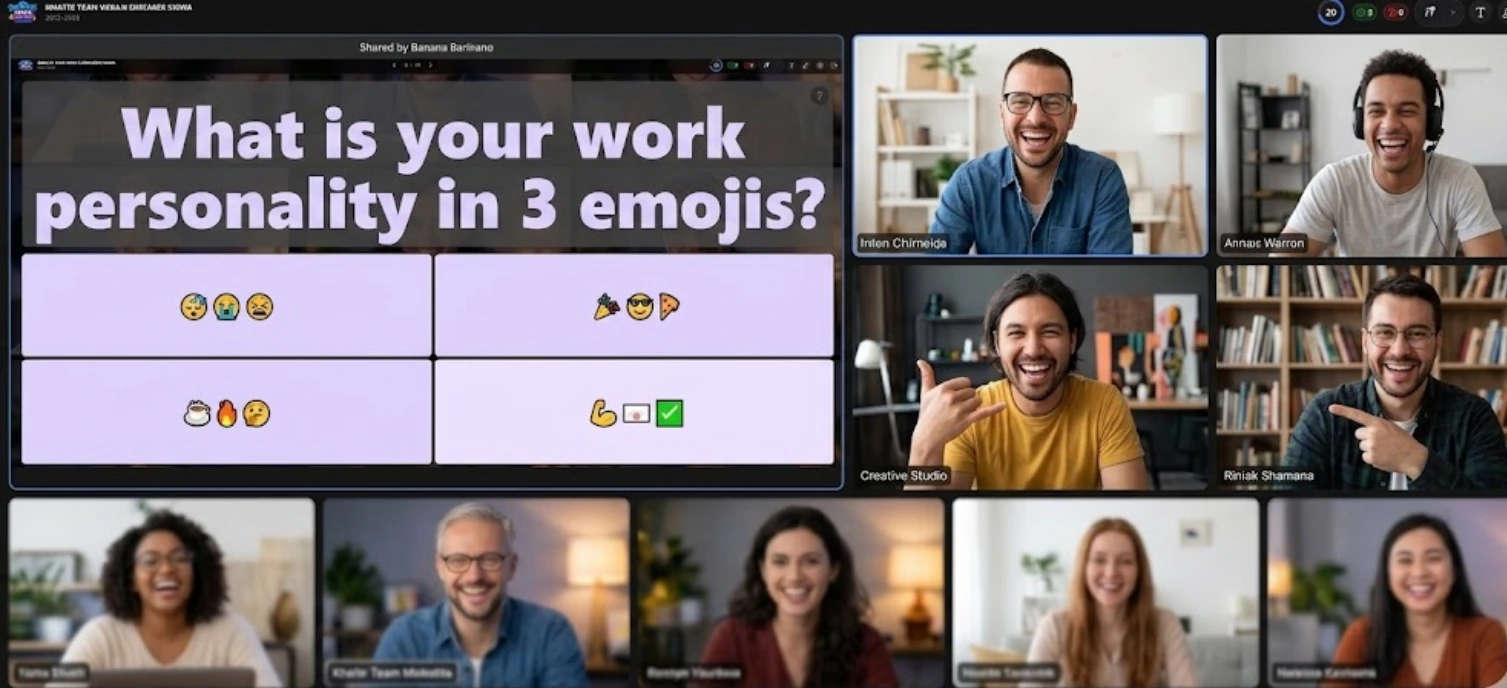
Run virtual trivia on Zoom or any video platform. No downloads, teams join with a code.
See how it works →Team building activities that drive employee engagement
Team building and engagement overlap, but they are not the same thing. Team building is specifically about improving how people work together. When it is done well, it drives engagement as a byproduct.
11. Department knowledge challenge
How it works: Teams create quiz questions about their own department, then challenge another team to answer them.
How to run it: Ask each department to submit 5 – 10 questions about what they do, recent projects, or key knowledge. Combine them into one quiz and run a live session where teams compete against each other.
Time needed: 15 – 30 minutes
This turns internal knowledge into a game – Engineering quizzes Marketing, Marketing quizzes Sales – and everyone learns how the company actually works.
Tip: Use a grid-style format with categories like “Product Roadmap,” “Customer Stories,” and “Company History” to make it feel like a game show.
12. Quarterly trivia league
How it works: A recurring trivia competition where teams earn points over multiple sessions.
How to run it: Host one quiz per month, track scores on a shared leaderboard, and announce standings after each round. At the end of the quarter, reward the top team with a small prize.
Time needed: 20 minutes per session
The ongoing leaderboard keeps people engaged between sessions – it turns one-off activities into something teams actually care about.
13. Hackathon or innovation day
How it works: Teams spend a focused block of time working on ideas outside their usual responsibilities.
How to run it: Set aside half a day, let teams form around ideas, and ask each group to present a short demo or concept at the end. Keep it simple – no complex rules or approvals.
Time needed: Half day
It encourages creativity, cross-team collaboration, and gives people a break from routine – with the bonus that some ideas may actually be worth implementing.
14. Escape room challenge
How it works: Teams solve puzzles together under time pressure to “escape” a scenario.
How to run it: Book a physical escape room or use an online version. Split employees into small groups and give them a fixed time limit (usually 45 – 60 minutes) to complete the challenge.
Time needed: 45 – 60 minutes
This reveals how teams communicate under pressure – and the debrief afterward often surfaces useful insights about collaboration.
15. CSR project day
How it works: Teams participate in a community-focused activity together.
How to run it: Choose a simple project – volunteering, donation packing, or a local cleanup. Organize teams, assign roles, and complete the activity in a single day.
Time needed: Half day to full day
Unlike competitive activities, this builds engagement through shared purpose – especially effective for new hires and cross-department teams.
More team building resources:
Employee engagement activities by team type and industry
Generic lists miss the point. What works for a software team of 12 does not necessarily translate to a hospital shift or a retail floor. Here is how to adapt activities for specific contexts.
HR teams
Replace the annual engagement survey with a monthly 5-question quiz-format pulse check. Employees answer faster, completion rates are higher, and the data is more frequent. HR teams can also use quiz results to identify knowledge gaps before they become problems.
Sales teams
Sales teams are already competitive, so lean into it. Weekly product knowledge trivia keeps the team sharp on what they are selling and creates a natural moment of team interaction outside of pipeline reviews. Leaderboards work here especially well because the culture already supports them.
Manufacturing and factory workers
Desk-based activities do not translate to factory floors. Focus on shift-level recognition, physical challenges that work in the space, and brief end-of-shift team moments. Safety knowledge quizzes – short, visual, run on a shared screen – can double as both training and engagement.
Healthcare and hospitals
Shift workers need low-friction, high-recognition activities. Quick compliance or protocol quizzes during handover meetings keep knowledge current and create a moment of shared interaction. Recognition during shift changeovers costs nothing and compounds over time.
Tech and IT companies
Tech teams respond well to internal hackathons, debugging challenges, and tech trivia quiz nights that celebrate the culture. The format should feel native – a screen-shared live game lands better than a mandatory fun event.
Corporate and large organizations
At scale, consistency matters more than creativity. A company-wide monthly trivia event – same format, different questions, tracked leaderboard – creates a shared ritual that holds across departments and geographies. TriviaMaker’s Crowd Mode handles audiences up to 2,000 with no special setup.
How to build an employee engagement activities calendar
Ad hoc activities fade. A calendar makes engagement systematic – something that happens because it is planned, not because someone remembered to organize it that week.
A simple monthly cadence
- Week 1: Recognition moment – peer shout-outs, team accomplishment highlight
- Week 2: Learning activity – trivia, knowledge quiz, lunch-and-learn
- Week 3: Social activity – virtual coffee, team game, informal gathering
- Week 4: Pulse check – quick 5-question quiz to gauge mood and flag issues early
Adjust based on team size, culture, and available time. The point is to plan in advance so that engagement becomes a default rather than a reaction to low morale.
Quarterly and seasonal anchors
- January: New Year trivia kickoff – team predictions, year-in-review quiz
- February: Valentine’s Day team quiz – light, fun, good for morale mid-winter
- Q2: Spring wellness or outdoor challenge
- Q3: Summer competition series – weekly leaderboard across July and August
- Q4: End-of-year trivia league finals, holiday team event
Seasonal anchors give teams something to look forward to and make the engagement calendar feel like part of company culture rather than an HR initiative.
Set up recurring trivia events with TriviaMaker’s Playlists – queue multiple games to run back-to-back automatically.
Start building →Free and low-cost employee engagement activities
Budget is rarely the actual constraint. Most high-impact engagement activities cost nothing – they cost time and intention.
Completely free activities
- Peer recognition Slack or Teams channel
- “Walk and talk” 1:1s instead of desk meetings
- Rotating icebreaker question at meeting starts
- Lunch-and-learn sessions hosted by team members
- Book or podcast club (one pick per month, 20-minute discussion)
- Two truths and a lie during onboarding or team intros
Low-cost tools worth having
TriviaMaker’s free plan covers quiz creation, basic hosting, and player participation – enough to run a team trivia game with no budget. Paid plans unlock Crowd Mode for large groups, branded themes, and advanced analytics, but the free version is sufficient for most teams getting started.
Start with free activities, build the habit, then invest once you know what your team actually responds to.
Quick employee engagement activities for meetings (5 to 10 minutes)
Not every engagement activity needs to be an event. Some of the most effective ones take less than 10 minutes and happen inside meetings that already exist.

16. Icebreaker question of the week
How it works: A simple question asked at the start of a weekly meeting to get everyone talking.
How to run it: Pick one question (e.g., “What are you looking forward to this week?” or “What would your superpower be?”) and go around quickly for answers before starting the agenda.
Time needed: 3 – 5 minutes
It’s small, but it signals that the meeting is about people, not just tasks – which builds connection over time.
17. Spin the wheel challenge
How it works: A high-energy wheel game where each spin reveals a surprise question, challenge, or activity for the team.
How to run it: Launch a wheel game, share your screen, and take turns spinning. Participants answer questions or complete quick challenges based on where the wheel lands.
Time needed: 5 – 10 minutes
This format adds unpredictability and excitement to any meeting – with TriviaMaker’s wheel style, you can create a fun, game-show vibe instantly without any prep.
18. One-word check-in
How it works: Each person shares one word describing how they feel before the meeting starts.
How to run it: Go around the group quickly and ask each person for one word. No explanations needed – just the word.
Time needed: 2 – 3 minutes
It’s fast and surprisingly revealing – helping managers understand team mood without formal surveys.
19. Rose, thorn, bud
How it works: A quick reflection where each person shares a positive (rose), a challenge (thorn), and something upcoming (bud).
How to run it: Ask 2 – 3 team members per meeting (or rotate weekly) to share their rose, thorn, and bud in under a minute each.
Time needed: 5 minutes
This creates honest conversations without turning meetings into long discussions.
20. Meeting-end appreciation round
How it works: A quick closing ritual where team members recognize each other.
How to run it: Before ending the meeting, invite anyone to give a short shout-out to a colleague. Keep it brief and optional.
Time needed: 1 – 2 minutes
It’s a small habit, but it shifts how meetings end – from tasks to recognition – which compounds over time.
Run a 5-question trivia round in your next meeting. Takes 3 minutes to build, 8 minutes to play.
Start your first quiz →Frequently Asked Questions
What are the best employee engagement activities?
The best employee engagement activities are those that are easy to join, encourage interaction, and can be repeated regularly. Top examples include team trivia games, peer recognition programs, quick meeting icebreakers, virtual coffee chats, and monthly team challenges. Activities that take under 10 minutes – like a 5-question trivia quiz – tend to get the highest participation.
What are quick employee engagement activities for meetings?
Quick engagement activities for meetings include icebreaker questions, one-word check-ins, short trivia rounds, and appreciation shout-outs. A 5-question trivia game is one of the most effective options – it takes under 10 minutes, requires no setup for participants, and instantly boosts energy and participation.
What are the best team building activities for remote teams?
Virtual team building activities work best when everyone participates at the same time. Online trivia games are highly effective because players join from any device, answer in real time, and see a live leaderboard. Other great options include virtual coffee chats, online escape rooms, photo challenges, and async quizzes for distributed teams.
How do you improve employee engagement quickly?
The fastest way to improve employee engagement is to introduce small, repeatable activities into existing meetings. Start with a weekly 5-minute engagement moment – such as a trivia quiz, recognition round, or icebreaker question. Consistency matters more than scale, so focus on simple activities that teams actually enjoy and look forward to.
Why are trivia games effective for employee engagement?
Trivia games are effective because they combine competition, participation, and instant feedback. Everyone can join easily, results are visible in real time, and the format naturally encourages interaction. This makes trivia one of the highest-performing engagement activities for both in-office and remote teams.
Putting it together
Employee engagement does not require a big program or a dedicated budget line. It requires repetition – small, consistent moments of connection that add up over time. The activities in this guide work because they are low-friction, socially driven, and repeatable.
Start with one activity this week. A 5-question trivia quiz in your next team meeting, a peer recognition channel in Slack, or a simple icebreaker question. Build the habit before you build the calendar.
If trivia and quiz-based activities fit your team, TriviaMaker’s team building game library has ready-to-run templates for every occasion, from icebreakers to company-wide events. Free to get started, no setup required.